 Samuel S Sackett
| Father | Aaron Sackett (1760-1827) |
| Mother | Dorcas Clark (-1859) |
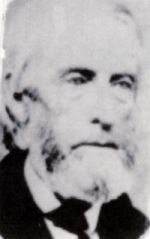
Samuel S Sackett
(1797–1880)
(Src: Louella Sexsmith)
(1797–1880)
(Src: Louella Sexsmith)
Samuel S Sackett, son of Aaron Sackett and Dorcas Clark, was born in Hamilton County, OhioG, on 1 September 1797.1 He died aged 82 in Twin Springs, Linn County, KansasG, on 9 February 1880.1 He married in Hanover TownshipG on 15 June 1820, Sarah Wickard.2,3 Sarah was born in Morgantown, Monongalia County, West VirginiaG, on 13 October 1799.
In 1850 Samuel was living in Sangamon County, IllinoisG, and was recorded in the census as Samuel Sackett, a farmer, aged 53 and born in Ohio. He was living with his wife Sarah, 51, in the household of his daughter Rosanna and son-in-law Barzilla Campbell.4
Obituary
In 1850 Samuel was living in Sangamon County, IllinoisG, and was recorded in the census as Samuel Sackett, a farmer, aged 53 and born in Ohio. He was living with his wife Sarah, 51, in the household of his daughter Rosanna and son-in-law Barzilla Campbell.4
Obituary
Death of Samuel Sackett.
Samuel Sackett, father of Alfred and Reuben Sackett, died at Twin Springs, Kansas, February 9th, in his eighty-third year. Mr. Sackett was for about twenty-five years a resident of this city, the most of that time being engaged in the drug business. A few years ago he removed to Kansas, where he haa since lived. He will be remembered by our citizens as an honorable and upright business man, a kind neighbor, a good citizen and a devoted Christian. He was born in Hamilton county, Ohio, Sept. 1, 1797. Reuben left Tuesday morning, to be present at the funeral.
—The Clinton Register, Clinton, Illinois, 13 Feb 1880, p 1
Samuel Sackett, father of Alfred and Reuben Sackett, died at Twin Springs, Kansas, February 9th, in his eighty-third year. Mr. Sackett was for about twenty-five years a resident of this city, the most of that time being engaged in the drug business. A few years ago he removed to Kansas, where he haa since lived. He will be remembered by our citizens as an honorable and upright business man, a kind neighbor, a good citizen and a devoted Christian. He was born in Hamilton county, Ohio, Sept. 1, 1797. Reuben left Tuesday morning, to be present at the funeral.
—The Clinton Register, Clinton, Illinois, 13 Feb 1880, p 1
Children of Samuel S Sackett and Sarah Wickard
- David Alexander Sackett+ b. 6 Mar 1821, d. 1 Jun 1895
- Alfred Moss Sackett b. 17 Apr 1822
- Jacob Sackett b. 25 Mar 1824
- Reuben R Sackett b. 29 Nov 1825
- Rosanna Sackett+ b. 15 Sep 1827, d. 20 Dec 1901
| Sackett line | 6th great-grandson of Thomas Sackett the elder of St Peter in Thanet 4th great-grandson of Simon Sackett the colonist |
Notes & Citations
- Obituary.
- Ohio Marriages Recorded in County Courts Through 1820 (The Ohio Genealogical Society), p905, "Sacket, Saml - Wickard, Sarah Jun 15, 1820 BUTL 00A 135."
- Records of Butler County, Ohio (), vol 1, p135, " I do hereby certify that on the 15th day of June A.D. 1820 I solomnized the Marriage of Mr. Samuel Sackett with Sarah Wickard. Filed and recorded June 21, 1820. John Rainey esquire a Justice of the Peace."
- 1850 United States Federal Census, Roll M432_127, p. 233
All Townships, Sangamon, Illinois
1485/1485
Campbell, Barzilla, 26, m, farmer, b. OH
Campbell, Rosana, 23, f, b. OH
Campbell, Sarah, 2, f, b. IL
Campbell, Laura, 3/12, f, b. IL
Sackett, Saml., 53, m, farmer, b. OH
Sackett, Sarah, 51, f, b. VA.
| Charts | Line 3 (American) |
| Generation.Tree | 7O.3 |
| Last Edited | 22 Apr 2026 |
| Research Status | Partly researched |
David Alexander Sackett1,2
| Father | Samuel S Sackett (1797-1880) |
| Mother | Sarah Wickard (1799-) |
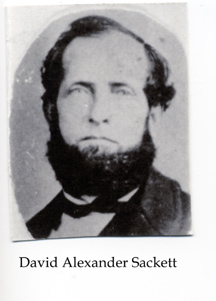
(Src: Louella Sexsmith)
David Alexander Sackett, son of Samuel S Sackett and Sarah Wickard, was born in Hanover Township, Butler County, OhioG, on 6 March 1821. He died aged 74 in Ventura County, CaliforniaG, on 1 June 1895. He married first in Ogle County, IllinoisG, on 4 March 1841, Sarah Lawrence, daughter of John Lawrence and Susan ___. Sarah was born at Bunker Hill, Kent, EnglandG, on 23 June 18194 and baptized at Tudeley and Capel, KentG.5 She died aged 39 in Petaluma, Sonoma County, CaliforniaG, on 6 May 18593,6 and was buried at Cypress Hill Memorial Park, PetalumaG.7 He married second in PetalumaG on 29 March 1860, Emily Jane Stevens.3 Emily was born in Kennebunkport, York County, MaineG, on 21 July 18323 and died aged 67 in Ventura, CaliforniaG, in 1900.3
In 1850 David was living in Elizabeth, Jo Daviess County, IllinoisG, and was recorded in the census as David Sackett, a farmer, aged 29 and born in Ohio. Living with him were his wife Sarah, 28, and their children, Samuel, 9, Rosetta, 7, and Henrietta, aged two. There were also two male laborers in the household.8
In 1860 he was living in Petaluma, Sonoma County, CaliforniaG, and was recorded as D A Sackett, a farmer, aged 39 and born in Ohio. Living with him were his second wife, Emaline, 26, and his children by his first marriage: Samuel, 19, Henrietta, 11, Emma, 9, Lucetta, 6, and Anetta, aged three. There were also a female servant and a young man, probably a farm laborer, in the household.9
In 1850 David was living in Elizabeth, Jo Daviess County, IllinoisG, and was recorded in the census as David Sackett, a farmer, aged 29 and born in Ohio. Living with him were his wife Sarah, 28, and their children, Samuel, 9, Rosetta, 7, and Henrietta, aged two. There were also two male laborers in the household.8
In 1860 he was living in Petaluma, Sonoma County, CaliforniaG, and was recorded as D A Sackett, a farmer, aged 39 and born in Ohio. Living with him were his second wife, Emaline, 26, and his children by his first marriage: Samuel, 19, Henrietta, 11, Emma, 9, Lucetta, 6, and Anetta, aged three. There were also a female servant and a young man, probably a farm laborer, in the household.9
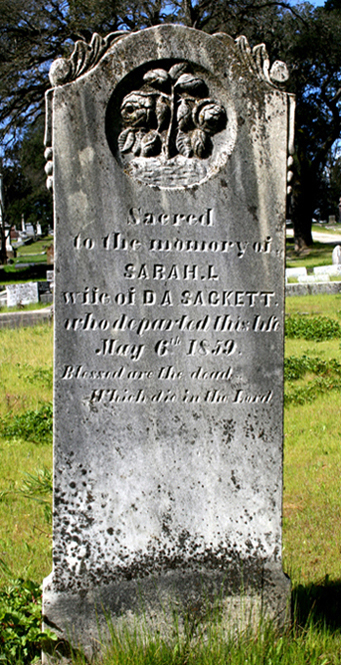
Sarah (Lawrence) Sackett (1819–1859), Cypress Hill Memorial Park, Petaluma, California
(Src: Find A Grave, Eric McGuire)
(Src: Find A Grave, Eric McGuire)
Children of David Alexander Sackett and Sarah Lawrence
- Samuel Arthur Sackett+ b. 22 Nov 1841, d. 20 Feb 1932
- Roseta Elvira Sackett b. 6 Dec 1843, d. 14 Dec 1890
- Henrietta Ella Sackett b. 25 Aug 1845, d. Aug 1865
- Marietta Emma Lillie Sackett b. 13 Dec 1850, d. 27 Apr 1940
- Lydia Lucetta Sackett+ b. 1 Jun 1854, d. 7 Nov 1931
- Sarah Anetta Sackett b. 27 Sep 1857
Children of David Alexander Sackett and Emily Jane Stevens
- William Menzo Sackett b. 7 Sep 1861, d. 18 Apr 1862
- Harry Pitman Sackett b. 10 Jan 1863, d. 18 Apr 1927
- George Lincoln Sackett b. 3 Jan 1865, d. 12 Oct 1925
- Harriet M Sackett b. 27 Jun 1868, d. 11 Jan 1954
| Sackett line | 7th great-grandson of Thomas Sackett the elder of St Peter in Thanet 5th great-grandson of Simon Sackett the colonist |
Notes & Citations
- Charles Weygant, The Sacketts of America, not recorded.
- Data on David Alexander Sackett researched by Louella Sexsmith.
- Sackett database, 4184 David Alexander Sackett.
- Heritage Consulting, "Millennium File" (Ancestry transcript), unsourced record, "Sarah Lawrence, b. Jun [no year given] at Bunker Hill, Kent, father John Lawrence, spouse David Alexander Sackett, child Samuel Arthur Sackett."
- Baptisms Register, Tudeley and Capel, Kent (Ancestry transcript), "28 Jun 1819, Sarah Lawrence d. John Lawrence & Susan."
- Gravestone.
- Find a Grave.
- 1850 United States Federal Census, Roll M432_111, p. 175b, image 356
Elizabeth, Jo Daviess, Illinois
Sackett, David, 29, farmer, real estate $1,900, b. OH
Sackett, Sarah, 28, b. England
Sackett, Samuel A, 9, b. IL
Sackett, Rosetta A, 7, b. IL
Sackett, Heneretta C, 2, b. IL
Irish, Charles, 25?, labourer, b. NY
Cambell, Samuel F, 49?, labourer, b. NJ. - 1860 United States Federal Census, Roll M653_69, p. 586, Image 586, FHL film 803069
Petaluma, Sonoma County, California
D A Sackett, 39, farmer, real estate $5,000, personal estate $4,000, b. OH
Emaline Sackett, 26, b. ME
Saml Sackett, 19, b. IL
Henrietta Sackett, 11, b. IL
Emma Sackett, 9, b. IL
Lusetta Sackett, 6, b. OR
Annett Sackett, 3, b. CA
Eliza McCarty, 22, servt, b. Ireland
Edwin Goodall, 17, b. England.
| Charts | Line 3 (American) |
| Generation.Tree | 8P.3 |
| Last Edited | 18 Aug 2024 |
| Research Status | Partly researched |
Rosanna Sackett
| Father | Samuel S Sackett (1797-1880) |
| Mother | Sarah Wickard (1799-) |
Rosanna Sackett, daughter of Samuel S Sackett and Sarah Wickard, was born in Hanover Township, Butler County, OhioG, on 15 September 1827.1 She died aged 74 in Ottawa, Franklin County, KansasG, on 20 December 19011 and was buried at Highland Cemetery, OttawaG.3 She married in Sangamon County, IllinoisG, on 24 March 1847, Barzilla Campbell, son of John Nowe Campbell and Phebe Clark.2 Barzilla was born in Butler CountyG on 29 July 1824.1 He died aged 79 in Ottawa, Franklin County, KansasG, on 21 February 19041 and was buried at Highland Cemetery, OttawaG.3
In 1850 Rosanna was living in Sangamon County, IllinoisG, in the household of her husband Barzilla Campbell, 26, a farmer, and was recorded in the census as Rosana Campbell, aged 23 and born in Ohio. Living with them were their children, Sarah, 2, and Laura, aged three months. Also in the household were Rosanna's parents, Samuel, 53, and Sarah, 51.4
In 1860 she was living in Clinton, DeWitt County, IllinoisG, in the household of her husband Barzilla Campbell, 35, a farmer, and was recorded as Rosena Campbel, aged 33. Living with them were their children, Nettie, 12, Laura, 10, Robert, 4, and Christina (later known as Rosella), aged one.5
In 1870 she was living in Scott, Linn County, KansasG, in the household of her husband Baz Campbell, 46, a farmer, and was recorded as Roosanna Capbell [sic], aged 43. Living with them were their children, Robert, 13, Etta, 9, and Annie, aged eight.6
In 1880 Rosanna was living in ScottG in the household of her husband Barzilla Campbell, 55, a farmer, and was recorded in the census as Roxanna Campbell, aged 50. Living with them was their daughter Rosella, aged 21.7
In 1900 she was living in Ottawa, Franklin County, KansasG, in the household of her husband Barzilla Campbell, 75, a farmer, and was recorded as Rosanna Campbell, aged 72. They owned their home free of mortgage. Living with them were their children, Ella, 41, and John, 44. Also in the household were John's wife Julia, 35, and their son Vannie, aged eight.8
In 1850 Rosanna was living in Sangamon County, IllinoisG, in the household of her husband Barzilla Campbell, 26, a farmer, and was recorded in the census as Rosana Campbell, aged 23 and born in Ohio. Living with them were their children, Sarah, 2, and Laura, aged three months. Also in the household were Rosanna's parents, Samuel, 53, and Sarah, 51.4
In 1860 she was living in Clinton, DeWitt County, IllinoisG, in the household of her husband Barzilla Campbell, 35, a farmer, and was recorded as Rosena Campbel, aged 33. Living with them were their children, Nettie, 12, Laura, 10, Robert, 4, and Christina (later known as Rosella), aged one.5
In 1870 she was living in Scott, Linn County, KansasG, in the household of her husband Baz Campbell, 46, a farmer, and was recorded as Roosanna Capbell [sic], aged 43. Living with them were their children, Robert, 13, Etta, 9, and Annie, aged eight.6
In 1880 Rosanna was living in ScottG in the household of her husband Barzilla Campbell, 55, a farmer, and was recorded in the census as Roxanna Campbell, aged 50. Living with them was their daughter Rosella, aged 21.7
In 1900 she was living in Ottawa, Franklin County, KansasG, in the household of her husband Barzilla Campbell, 75, a farmer, and was recorded as Rosanna Campbell, aged 72. They owned their home free of mortgage. Living with them were their children, Ella, 41, and John, 44. Also in the household were John's wife Julia, 35, and their son Vannie, aged eight.8
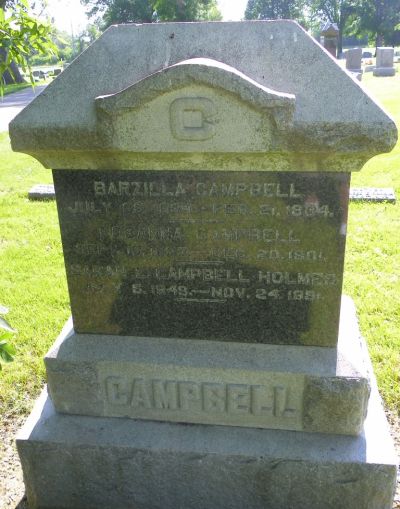
Rosanna Sackett (1827–1901), Highland Cemetery, Ottawa, Kansas
(Src: Find A Grave, DK Paddock)
(Src: Find A Grave, DK Paddock)
Children of Rosanna Sackett and Barzilla Campbell
- Sarah E Campbell+ b. 5 Jul 1848, d. 24 Nov 1891
- Laura Campbell b. 1850
- John Robert Campbell+ b. May 1856
- Rosella "Ella" Campbell b. May 1859
- Etta Campbell b. c 1861
- Annie Campbell b. c 1862
City News Briefs
Mrs Rosanna Campbell, the wife of Barzellia Campbell, died at her home on East Logan Street, beyond the city limits, this morning. Mrs Campbell was seventy two years old and had been sick for a long time. Her husband and several grown children survive her. Only one child, a daughter, Ella, is now living at home. The funeral will occur at the North Ottawa Methodist Church tomorrow afternoon at 2 o'clock.
—The Evening Herald, Ottawa, Franklin county, Kansas, 21 Dec 1901, p 2
| Sackett line | 7th great-granddaughter of Thomas Sackett the elder of St Peter in Thanet 5th great-granddaughter of Simon Sackett the colonist |
Notes & Citations
- Gravestone.
- "Illinois, Marriage Index, 1860–1920" (Ancestry transcript), "24 Mar 1847, Sangamon, Illinois, Rosanna Sacket & Barzilla Campbell."
- Find a Grave.
- 1850 United States Federal Census, Roll M432_127, p. 233
All Townships, Sangamon, Illinois
1485/1485
Campbell, Barzilla, 26, m, farmer, b. OH
Campbell, Rosana, 23, f, b. OH
Campbell, Sarah, 2, f, b. IL
Campbell, Laura, 3/12, f, b. IL
Sackett, Saml., 53, m, farmer, b. OH
Sackett, Sarah, 51, f, b. VA. - 1860 United States Federal Census, Page 588, FHL film 803174
Clinton, DeWitt, Illinois, 26/27 Jun 1860
Campbel, Brazilian, 35, fmr, real estate $2000, personal estate $1000, b. O
Campbel, Rosena, 33, b. IN
Campbel, Nettie, 12, b. IL
Campbel, Laura, 10, b. IL
Campbel, Robt, 4, b. IL
Campbel, Christina, 1, b. IL. - 1870 United States Federal Census, Roll M593_438, p 123B, FHL film 545937
Scott, Linn, Kansas
Capbell, Baz, 46, farmer, real estate $1100, personal estate $2500, b. OH
Capbell, Roosanna, 43, keeping house, b. OH
Capbell, Robert, 13, at school, b. IL
Campbell, Etta, 9, at school, b. IL
Campbell, Annie, 8, at school, b. IL
Homes, B L, 26, clerk & dry goods ret, b. KY
Homes, Etta, 22, no occupation, b. IL
Peterson, Jennie, 18, domestic servant, b. IN. - 1880 United States Federal Census, Roll 386, p 120A, Enumeration District 131
Scott Township, Linn, Kansas, 11 Jun 1880
Campbell, Boazilla, head, 55, farmer, b. OH, father b. PA, mother b. OH
Campbell, Roxanna, wife, 50, house keeping, b. OH, father b. OH, mother b. VA
Campbell, Rosella, daughter, 21, helping Ma, b. IL, father b. OH, mother b. OH. - 1900 United States Federal Census, Page 1, Enumeration District 0089, FHL microfilm 1240480
Ottawa, Franklin, Kansas, 1 Jun 1900
Campbell, Barzilla, head, b. Jul 1824, 75, m. 53y, farmer, b. OH, father b. PA, mother b. MD, home owned free of mortgage
Campbell, Rosanna, wife, b. Sep 1827, 72, m. 53y, 6 ch, 4 living, b. OH, father b. PA, mother b. VA
Campbell, Ella, daughter, b. May 1859, 41, div, 1 ch, not living, b. IL, father b. OH, mother b. PA
Campbell, John R, son, b. May 1856, 44, m. 17y, agent (real estate), b. IL, father b. OH, mother b. OH
Campbell, Julia H, daughter-in-law, b. Oct 1864, 35, m. 17y, 5 ch, 1 living, b. NJ, father b. NJ, mother b. NJ
Campbell, Vannie, grandson, b. Sep 1891, 8, at school, b. KS, father b. IL, mother b. NJ.
[The census enumerator was John R Campbell]
| Charts | Line 3 (American) |
| Generation.Tree | 8P.3 |
| Last Edited | 22 Mar 2021 |
| Research Status | Completed |
Samuel Arthur Sackett
| Father | David Alexander Sackett (1821-1895) |
| Mother | Sarah Lawrence (1819-1859) |
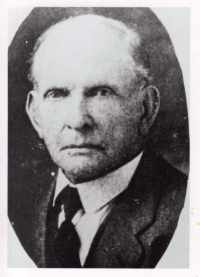
Samuel Arthur Sackett
(1841–1932)
(Src: Find A Grave, Paull Gunderson)
(1841–1932)
(Src: Find A Grave, Paull Gunderson)
Samuel Arthur Sackett, son of David Alexander Sackett and Sarah Lawrence, was born in Rock Island, Rock Island County, IllinoisG, on 22 November 1841.1 He died aged 90 in Salt Lake City, UtahG, on 20 February 19321,2 and was buried at Brigham City Cemetery, Box Elder County, UtahG.1,3 He married first in Brigham CityG on 26 October 1876, Mary Peterson, daughter of Hans Nielsen Peterson and Karen Sophia Andreasdatter.1 Mary was born in Brigham City, Box Elder County, UtahG, on 20 May 1860.1 She died aged 70 in Salt Lake CityG on 10 April 1931 and was buried at Brigham City, Box Elder County, UtahG.4,5 He married second polygamously in Logan, Cache County, UtahG, on 16 July 1884, Mary's sister, Laura Andrea Peterson.1 Laura was born in Brigham City, Box Elder County, UtahG, on 17 June 1864.1 She died aged 93 in Brigham CityG on 8 December 19571 and was buried there on 11 December 1957.1
In 1850 Samuel was living in Elizabeth, Jo Daviess County, IllinoisG, in the household of his parents David and Sarah, and was recorded in the census as Samuel A Sackett, aged nine and born in Illinois.6
In 1860 he was living in Petaluma, Sonoma County, CaliforniaG, in the household of his father David and stepmother Emaline, and was recorded as Samuel Sackett, aged 19 and born in Illinois.7
In 1880 he was living at Blackfoot, Oneida County, IdahoG, and was recorded as Samuel A Sackett, a carpenter, aged 38. Living with him were his wife Mary, 20, and their children, Sarah, 3, and twins David and Daisy, aged seven months.8
In 1910 he was living in Box ElderG and was recorded as Samuel A Sackett, a house carpenter, head of household, aged 68. He owned his home on mortgage. Living with him were his wife Mary, 49, and their sons, Estress, 25, Clarry, 17, Ephraim, 15, Golden, 12, Ervin, 10, and Orrel, aged nine.9
In 1920 he was living at Acad Avenue, Provo, Utah County, UtahG, and was recorded as Samuel A Sackett, head of household, aged 78. Living with him were his wife Mary, 59, their son Oral D, 17, and their divorced daughter Anetta Hudson, 42.10
In 1930 he was living at Iowa Avenue, Salt Lake CityG, and was recorded as Samuel A Sackett, head of household, aged 88. Living with him were his wife Mary, 70, and their son Ervin, 30, and daughter-in-law Althora, 27.11
Samuel's memoirs
Samuel left a fascinating account of life in the Old West, including details of religious discrimination suffered, particularly because of his polygamy.
Samuel's obituary
Mary's obituary
In 1850 Samuel was living in Elizabeth, Jo Daviess County, IllinoisG, in the household of his parents David and Sarah, and was recorded in the census as Samuel A Sackett, aged nine and born in Illinois.6
In 1860 he was living in Petaluma, Sonoma County, CaliforniaG, in the household of his father David and stepmother Emaline, and was recorded as Samuel Sackett, aged 19 and born in Illinois.7
In 1880 he was living at Blackfoot, Oneida County, IdahoG, and was recorded as Samuel A Sackett, a carpenter, aged 38. Living with him were his wife Mary, 20, and their children, Sarah, 3, and twins David and Daisy, aged seven months.8
In 1910 he was living in Box ElderG and was recorded as Samuel A Sackett, a house carpenter, head of household, aged 68. He owned his home on mortgage. Living with him were his wife Mary, 49, and their sons, Estress, 25, Clarry, 17, Ephraim, 15, Golden, 12, Ervin, 10, and Orrel, aged nine.9
In 1920 he was living at Acad Avenue, Provo, Utah County, UtahG, and was recorded as Samuel A Sackett, head of household, aged 78. Living with him were his wife Mary, 59, their son Oral D, 17, and their divorced daughter Anetta Hudson, 42.10
In 1930 he was living at Iowa Avenue, Salt Lake CityG, and was recorded as Samuel A Sackett, head of household, aged 88. Living with him were his wife Mary, 70, and their son Ervin, 30, and daughter-in-law Althora, 27.11
Samuel's memoirs
Samuel left a fascinating account of life in the Old West, including details of religious discrimination suffered, particularly because of his polygamy.
Samuel's obituary
Samuel Arthur Sackett, 90, retired contractor of Brigham City, who resided at 256 Iowa street, died in a local hospital Saturday at 2 a.m. of bronchial pneumonia.
Mr. Sackett was born in Rockland, Ill., November 22, 1841. He had been a resident of Utah for 60 years and for the last 11 years he had resided in Salt Lake.
Surviving are nine sons and seven daughters: John of Ogden; Estress, Orvil and William Sackett of Brigham City; Ephraim, Harry and Ervin Sackett of Salt Lake and Don Sackett of Park City; and Golden D Sackett of Los Angeles; Mrs Annetta Hudson of Los Angeles; Mrs Elvira Gilbert of Ogden; Mrs Alma Jones of Provo; Mrs Laura Gilbert and Mrs Ella Johnson of Brigham City; Mrs Maude Rock of Salt Lake and Mrs Ruby Okey of Parkway, Wyo.; and his widow, Laura Andrea Sackett of Brigham City.
Funeral services will be held in the Brigham City First ward L.D.S. chapel Tuesday at 1 p.m. The body may be viewed in the chapel from noon until 1 p.m. and interment will be in the Brigham City cemetery.
—Salt Lake Telegram, 20 Feb 1932, p. 13
Mr. Sackett was born in Rockland, Ill., November 22, 1841. He had been a resident of Utah for 60 years and for the last 11 years he had resided in Salt Lake.
Surviving are nine sons and seven daughters: John of Ogden; Estress, Orvil and William Sackett of Brigham City; Ephraim, Harry and Ervin Sackett of Salt Lake and Don Sackett of Park City; and Golden D Sackett of Los Angeles; Mrs Annetta Hudson of Los Angeles; Mrs Elvira Gilbert of Ogden; Mrs Alma Jones of Provo; Mrs Laura Gilbert and Mrs Ella Johnson of Brigham City; Mrs Maude Rock of Salt Lake and Mrs Ruby Okey of Parkway, Wyo.; and his widow, Laura Andrea Sackett of Brigham City.
Funeral services will be held in the Brigham City First ward L.D.S. chapel Tuesday at 1 p.m. The body may be viewed in the chapel from noon until 1 p.m. and interment will be in the Brigham City cemetery.
—Salt Lake Telegram, 20 Feb 1932, p. 13
Mary's obituary
Mary Sackett
Mrs. Mary Sackett, 70, wife of Samuel A. Sackett, died at the family residence, 256 Iowa street, Friday morning of complications following a stroke suffered some time ago. She had resided in Salt Lake since 1922, coming here from Provo. She and Mr. Sackett were married in Brigham City in 1867 [sic: 1876], moving to Provo shortly afterward. Mrs. Sackett was a member of the L.D.S. church Relief society.
Besides her husband, ten of her sixteen children survive: Mrs. Anneta Hudson, Harry, Ephraim, Golden, Ervine and Don Sackett, all of Salt Lake; John L. Sackett of Ogden, Esdrus M. Sackett of Brigham City, Mrs. Alvir Gilbert of Ogden and Mrs. Julia Jones of Provo.
—Salt Lake Telegram, 11 Apr 1931, p. 15
Funeral
Sackett—Funeral services for Mrs. Mary Sackett, who died at her home, 256 Iowa street, April 10, will be held at the Eleventh ward chapel Sunday at 1 p.m., after which the body will be taken to Brigham City, where services will be held at the First ward chapel. Friends may call at the family home, 256 Iowa street, Sunday morning. Interment will take place at the Brigham City cemetery, under the direction of Lindquist Sons-Carlquist company.
—Salt Lake Telegram, 11 Apr 1931, p. 15
Mrs. Mary Sackett, 70, wife of Samuel A. Sackett, died at the family residence, 256 Iowa street, Friday morning of complications following a stroke suffered some time ago. She had resided in Salt Lake since 1922, coming here from Provo. She and Mr. Sackett were married in Brigham City in 1867 [sic: 1876], moving to Provo shortly afterward. Mrs. Sackett was a member of the L.D.S. church Relief society.
Besides her husband, ten of her sixteen children survive: Mrs. Anneta Hudson, Harry, Ephraim, Golden, Ervine and Don Sackett, all of Salt Lake; John L. Sackett of Ogden, Esdrus M. Sackett of Brigham City, Mrs. Alvir Gilbert of Ogden and Mrs. Julia Jones of Provo.
—Salt Lake Telegram, 11 Apr 1931, p. 15
Funeral
Sackett—Funeral services for Mrs. Mary Sackett, who died at her home, 256 Iowa street, April 10, will be held at the Eleventh ward chapel Sunday at 1 p.m., after which the body will be taken to Brigham City, where services will be held at the First ward chapel. Friends may call at the family home, 256 Iowa street, Sunday morning. Interment will take place at the Brigham City cemetery, under the direction of Lindquist Sons-Carlquist company.
—Salt Lake Telegram, 11 Apr 1931, p. 15
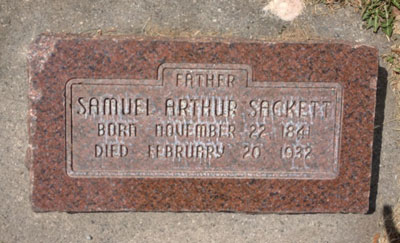
Samuel Arthur Sackett (1841–1932), Brigham City Cemetery, Utah
(Src: BillionGraves)
(Src: BillionGraves)
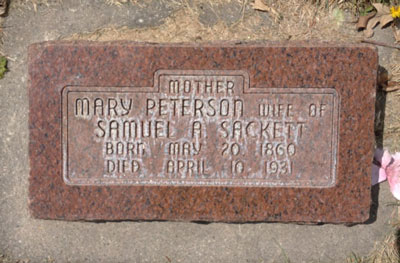
Mary (Peterson) Sackett (1860–1931), Brigham City Cemetery, Utah
(Src: BillionGraves)
(Src: BillionGraves)
Children of Samuel Arthur Sackett and Mary Peterson
- Sarah Anneta Sackett b. 15 Sep 1877, d. 21 Mar 1963
- Daisy Alberta Sackett b. 20 Dec 1879, d. 13 Aug 1889
- David Arthur Sackett b. 20 Dec 1879, d. 3 Sep 1881
- John LeRoy Sackett+ b. 16 Jan 1882, d. 29 Jun 1946
- Frank Roy Sackett b. 25 Feb 1883, d. 14 Sep 1889
- Estress Manley Sackett+ b. 15 Oct 1884, d. 8 Mar 1968
- Mary Elvira Sackett b. 9 Oct 1886, d. 8 Dec 1957
- Julia Hortence Sackett b. 30 Aug 1891, d. after 1932
- Harry Lincoln Sackett b. 14 Dec 1892, d. 16 Nov 1966
- Ephraim Anzel Sackett b. 1 Aug 1894, d. 14 Nov 1953
- Kenneth Leo Sackett b. 14 Feb 1896, d. 17 Feb 1896
- George Sackett b. 20 Jan 1897, d. 13 Jan 1976
- Golden Noble Sackett+ b. 10 Dec 1897, d. 13 Jan 1970
- Ervin Alfred Sackett b. 10 Aug 1900
- Oral Don Sackett+ b. 28 Mar 1902, d. 4 Aug 1973
- Edith Bernice Sackett b. 11 Dec 1904, d. 12 Jan 1905
Children of Samuel Arthur Sackett and Laura Andrea Peterson
- Laura Sophia Sackett b. 4 Jan 1884, d. 17 Dec 1972
- Maud Lenora Sackett b. 8 Aug 1887, d. 11 Jun 1973
- Samuel Marcus Sackett b. 28 Mar 1893, d. 16 Mar 1903
- George Menzo Sackett b. 19 Feb 1896, d. 25 Jun 1916
- Orval Ephraim Sackett+ b. 15 Oct 1898, d. 8 Apr 1980
- Ella Cleora Sackett b. 17 Oct 1902, d. 28 Aug 1979
- Ruby Odean Sackett b. 5 Mar 1905, d. 17 Jul 1996
- William Chester Sackett b. 5 Jul 1907, d. 30 Jun 1999
Memoirs of Samuel Arthur Sackett (1841–1932)
as told by him to his daughter Julia H Sackett, 1930.
I was born November 22, 1841, on the bank of the Mississippi River in Rock Island, Rock Island County, Illinois just across the river from Davenport, Iowa. My father was David Alexander Sackett, my mother Sarah Lawrence.
I am the oldest in a family of six children, one boy and five girls. When I was about four years of age my father moved his family to Golena where we lived until I was nine years old. My two oldest sisters were born here. Rosetta Elvira, born December 6, 1843, and Heneretta Ella, born August 15, 1845. They have both passed on at this writing. Then we moved to what was known as Elizabeth Settlement situated on the bank of Apple River. We located on Tarapin Ridge. My third sister was born at this place in December 1850. She was named Emma and is eighty years old at the time of this story. We got our outfits for crossing the Plains ready while living at this place.
In 1853 we moved down across the Mississippi River into Iowa. We called this place our starting point and dated our trip crossing the Plains from this place. We waited here for a short time for other wagons to join us. When we had fifteen wagons in our company, we started on the long trail.
Father had two wagons and we were driving Oxen. The women and children were the only ones riding. Our first stop was at Council Bluffs located on the banks of the tributary of the Missouri River. This was the last settlement of white people and we waited here for an enlargement of our company before going into the Indian Country.
Leaving here with one hundred and fifteen wagons, we went about five miles and had to Ferry across the Missouri River. It took two days for the company to accomplish this feat. From here we traveled up the Platt River until we had to cross it. This was about the last place for some distance that the feeding was good so we made camp. This was a quicksand region and while playing with my playmates I discovered that by moving my feet I could work myself down into the sand. I kept this up until I was in the sand up to my knees then I found I could not get out so I sent my playmates after my father. When he saw the condition I was in, he got three or four end-gates from the wagons and put them on the sand around me so they could stand on them without sinking into the sand. They put a band around me and put a pole through it, father on one end and another man on the other end pulling, and me working my feet to loosen the sand until they got me out of it. My lesson was well learned.
About two days later we started to move again. Father, a companion, and myself started out ahead of the company to locate a good place to camp before the wagons arrived. While making this trip, I met with my first accident. I was placed on a horse from which I fell and was picked up for a dead child. During this trip we were caught in a terrific hail storm. We were close to an Indian Camp or Lodge, seven or eight in all. One of the Indians called us in to his Teepee to get out of the storm. We could see our wagons coming. The storm lasted only a few minutes, but was so hard and the hail was so large that the stock became frightened and bolted. Hail was packed like ice up to the hubs of the wagon wheels. One man having a very choice horse, held on to it, but his hands were beaten to sores and his horse was all skinned by the hail. After the storm had cleared several parties started to gather the stock. They hunted the rest of the day and all of the second day returning in the evening. They had traveled miles to recover them.
In crossing the Platt River to the Elk Horn, there was a very hard wind storm. It blew two pillows out of the wagon which mother was riding in. I recovered one of them but the wind kept the other one rolling so fast that I could not get my horse far enough ahead of it to get off and catch it. It took us three or four days to make this part of our journey. The last two days were very stormy. When we arrived at Elk Horn River, it had overflowed its bank. There were about fifteen hundred people waiting to cross it.
The first arrivals to this place had built a raft and were ferrying the members of their company across. My father's cousin, Fred Swatkey, was in our company. This was his third trip across the Plains and he knew of the hardships that we would be called upon to suffer so we were better prepared in some ways for the journey than the rest of the company, especially with guns and ammunition. He had made his wagon box purposely to be used as a ferry in crossing the rivers. The contents of the wagons were taken across in his wagon box. The people were taken on the raft and the stock had to swim the river. It took five or six of us working night and day to get every thing across.
My companion, George Scroff, and myself were put to watch the stock as they came out of the water so none would stray away. We walked back and fourth for some time, then George suggested that we set a strip of dry grass afire that was in line of our walking and each one of us would watch one end of it. As the fire burned we had a shorter distance to walk and could see a long way by it's light. I would stand until the fire got near me, then would jump back. A little whiff of wind caused a blaze in the fire and I gave a big jump backwards and went right in the river. I gave a call for help and went straight to the bottom. George came to my rescue.
The river was very swift. I was taken down with the current aways and as I came out of the water George saw me by the light of the fire and pulled me out. This was about ten o'clock at night. The men worked over me for some time and then gave me up for dead and wanted to get back to work. Father went to the wagon and told mother what the men thought but she would not listen to the idea of burying me and insisted that I would be buried alive. So father went back to where I was lying and told the men how mother felt. They said, "All right we have no time to waste over a dead person with so much to do," and left father to work with me. He kept working over me until the next afternoon, about fourteen hours, before I showed any signs of life.
From here until we reached our journeys end the Indians got away with our stock twice but they were recovered both times without much trouble.
One time while camping on the Plains, father was cooking supper, an Indian came to camp and shook his blanket over the food cooking in the kettles in the hope of scaring us from camp so they could have the food. They had the idea by doing this the white people would leave the food for them to eat. Father grabbed the Indian, chained him to the wagon wheel and gave him a whipping. This frightened every one in camp thinking it would cause trouble with the Indians. A short time after this incident took place six Indians came to camp. The Chief was one of them. Father explained the conditions and said, "Every one in camp was afraid their horses would be stolen and the camps molested," the Chief laughed and said he would send some Indians to camp at sundown to get the stock, promised to give them a good feed and return them in the morning at any time they wished them returned. Some of the folks were afraid to do this doubting the Chiefs word, but the stock that had been turned over to the Indians were returned in the morning and had been well fed.
Just as we were leaving camp, at the foot of the Cascade Mountains on the Columbia River, my sister Emma met with a very painful accident. The wagon in which she was riding went through a gully, it threw her against the brakes cutting a very deep gash in her check and knocked out some of her teeth. She still bears the scar from this cut.
We arrived in Fosters, Oregon, about October 4, 1853, just one hundred and four days from the day we left our camp in Iowa. We made camp under a large fir tree. Shortly after our arrival it started to storm and it was ninety-six days before we saw the sun. It was very wet but not so very cold.
This was new country. At this time we camped in Salem, Oregon, for a few days while father hunted for and decided on a place to locate. We finally settled on Beaver Creek in Benton County. Father built a house here of what was called shakes—slabs of wood cut from large pines. We lived here about a year. During this time my fourth sister was born January 1, 1854. She was named Lydia Lucetta. Late in the year of 1854 mother's health became very poorly and the doctor said, "It was too wet a climate for her." So after the harvesting was over we moved again.
This time we went into the Northern part of California. We lived here for a little better than two years.
In 1855 we lived in Green Mountain Gulch. One day I wanted to go prospecting. Father gave me a certain amount of work to do thinking I would not get it finished, and when I was finished, I obtained an old spoon and tin can from mother and started up the gulch. I found a crevice in a rock that looked pretty good and started to dig and scrape with my spoon. I found the rock was flat but could not remove it so went on up to the head of the gulch where a claim was located. It was run by Thomas and Jerry Sitton. I asked if I could borrow a pick. Thomas laughingly said, "Yes – shovel and pan too." So I returned to my rock removed it and scraped out a crevice clean with my spoon. I went to the river to pan it out but did not understand how to settle the gold.
Thomas Sitton being curious as to what I was doing had followed me to the river. On seeing me said, "My boy you have a whole pan of dirt." He helped me pan out the dirt then we returned to camp to show the rest of the men my find. Jerry Sitton looked at it and was going to put it in his bins but Thomas stopped him saying he had given it to me. Jerry did not approve but Tom was firm so we went to his cabin dried the dirt and blew out the black sand. He said, "You haven't a pan full of gold, but do you know how much money you will have?" I did not of course. He put it in a buck skin gold bag and told me I had six hundred dollars worth of gold and that I should take it to my father, which I did as fast as I could. I was very happy. It was through this incident that my oldest sister, Rosetta, met Thomas Sitton. Two years later they were married.
Mother's health did not improve, so the doctor ordered another move. We packed again and moved into middle California. While here her health improved somewhat and when she was able to travel we went down to Petaluma, Sonoma County, on a prospecting trip. My fifth sister, Annie was born here on September 27, 1857. While living here mother contracted Erysipelas. She passed away shortly after reaching home in the year of 1859.
In 1860 I went to Nevada and got a job hauling ore from the mines. I worked at this job for one year. In the fall of 1860 I hauled lumber out of the Sierra Nevada Mountains into Carson Valley using oxen for teams.
One bright sunny day I stopped in the shade of a large tree for lunch after tending my team, I spread my lunch, harnessed my team and went on down the trail and again fed the team and spread my lunch under another large tree. Looking up at the mountains I saw a small cloud but attaching no importance to it I went on eating my lunch. Without a warning a flash of lightening hit and splintered to atoms the first tree I had spread my lunch under.
I was working in a company of four at this time. I split from them, sold my team and outfit, and went prospecting for gold in the Humbolt Mountains. I knocked about the country for a while, lost all I had, and finally beat my way back to Gold Hill, Nevada. Here I obtained work shingling for the Mill foreman.
There was an epidemic raging here and from my position on the roof I could see seven or eight funerals a day. I was not feeling very well myself and seeing the town doctor coming down the street I crawled down from the roof and asked him if he could do any thing for me. He looked at my tongue, felt my pulse, asked some questions then said, "I can give you something to keep you alive for three or four days but you had better get out of this place." I immediately went to the foreman and explained matters to him. Everyone was leaving the place as fast as possible so I could not get passage on any of the conveyances. One day a man came along with a mule pack train and wanted someone to ride the bell mare of the train. He gave me the job. A mule would not follow a mule, so they had to use a horse for the lead of the train. At last I was on my way home. I traveled all day in the rain, slept in wet blankets that night and traveled all the next day in the rain. There was no way of drying my blankets so I slept the second night in wet blankets. The third night of this trip we reached Diamond Springs, where we made camp. By this time I was too sick to ride any farther so my pack was unloaded and I tried to get passage on the Stage which traveled to Folsom, a distance of thirty miles. The driver told me I could not get a seat in the stage for two months.
I went to the Boarding House Hotel for a room. The landlord seeing I was sick sent me to a room and had his wife bring me some toast and tea. While serving me she saw an Odd Fellow pin I was wearing. It was my father's. He had left it with me on a previous visit to me. She said her husband was a member of the same Lodge and that he was well acquainted with my father David Sackett and as much as I was his son they would see I was taken care of. He obtained a seat in the stage for me and gave me a letter of introduction and a list of places I was to stop at. I took the stage to Folsom, then the train to Sacramento. I went down the Sacramento River on a steam boat one hundred miles to San Francisco. I stopped at the Woodward Hotel. From here I went to Petaluma on another steam boat.
We arrived there sometime after dark the next day. I was taken from there to my home in a buggy. I was put to bed and father called a doctor. After three days father became discouraged and sent for a doctor from San Francisco. This doctor failed to obtain any response to his efforts. Then a doctor Klunez from Sacramento was called. He was considered the best in the State. Father told him not to spare horse flesh but to telegraph ahead for fresh horses to be ready for him. When he arrived he gave me twelve hours to live. My stepmother's sister was a homeopathic doctor but father had told her he didn't want any of her sugar coated pills. Her niece was a very fine musician (pianist). Having been sick for four weeks I was very restless and could not keep quiet. Music had a restful quieting effect on me so she would come and play for me everyday. She was in when the doctor gave me up. She ran home and told her mother and she came right over and asked permission to help me. The doctor said, "Yes, that she could not hurt me." She immediately rolled me in ice cold sheets (cold spring water). All three doctors were there and were very anxious to know what she could do for me and were very attentive. She kept putting fresh cold sheets on me for some few hours. Doctor Klunex staying on to see the effects of the treatment was quicker to see the results than the woman giving the treatment. He rushed to tell my father that the fever had been broken and I would live. I weighed one hundred and eighty-five pounds when I took sick and when I was able to be up and around again I weighed ninety-four pounds. This was in the winter of 1860–1861.
In the spring I planted a good sized garden for the family and undertook to look after the farming in general. The next fall a camp meeting was held and my folks wanted me to join the Church. I said I was willing to join a Church but didn't know which one to join that as far as I knew there wasn't any of them living up to the teachings of Christ that they only lived up to the part they like best. But if it would be any satisfaction to them I would join their Church. So I became a member of the Methodist Church in the spring of 1862. This lasted about three months.
The class leader of the Methodist Church was Henry Matrex. This class was the same as the testimony meeting of the Latter Day Saints Church, or of a prayer meeting.
He owned a large herd of hogs but didn't attempt to keep them fenced. He turned them loose and they damaged my garden twice. The next time the hogs were in my garden I turned loose a large vicious dog that I kept chained in the barn for a watch dog. He killed a couple of them and chewed others up until they later died from the effects. The next day Henry Matrex came over to borrow my shot gun. As I went into the house to get it he said, "I am going to kill your dog." "Not while I am alive," I answered. Angry words were passed between us and during them he made an insulting remark to my oldest sister, Rosetta, who was keeping house for us. I became more angry than ever and as he went out of the house, I followed him and ordered him off the place and told him to stay off.
Father was not home at this time. When he returned the next day Mr. Matrex reported my actions of the day before to him. Father said I had been right, the hogs had destroyed my garden several times and that if I had told him to stay off the place he had better stay off. Mr. Matrex reported this incident to the Methodist Church. The next day the Minister came to see me. I was plowing and had to get a certain amount done by night fall in order to get permission to go out for the evening. He talked so long that I told him he would have to follow the plough if he wanted to say more because I had to get my work finished. He told me I would have to apologize to Mr. Matrex for my conduct or be cut off from the Church. This made me so angry that I ripped out an Oath and said, "The church be damned, cut me off." This remark alone was enough to make me lose my membership. So the next day I received notice of my disfellowship from the Methodist Church.
My father David Sackett was married the second time in the fall of 1862 to Miss Emily Jane Stevens. There were four children born by this union three boys and one girl. The boys Harry, George, and William have passed on at the time of this writing. The girl, Harriett Sackett Ward, is still living in Ventura and my oldest sister is in Lake County.
In the spring, April 12, 1862, I was nearly twenty-one years of age. I left home and went into Nevada, Oregon, and Montana. My brother-in-law Thomas Sitton, an old hand miner and I started out to find [illegible] place toward the head waters of the Columbia River. On this trip I discovered [illegible] called the John Day River mines. They are called by that name to this day. The John Day River is a tributary to the Columbia River.
A town was started there and was called Canyon City, There were seventy-five men in our company. We crossed a bar in the river and while crossing my attention was attracted to a rock. I remarked that if we didn't go too far before camping I was coming back to examine it. We traveled three-fourths of a mile when we stopped for lunch.
I started back to investigate the rock I had seen and told the men if I hadn't returned when they were ready to move on where to cash my saddle and hide my horse. They tried to persuade me not to go because the Indians were mean and vicious and it was not safe to travel alone. But I was out prospecting and would not find anything along the trail. Back at the river I panned out a pan of dirt and got two or three dollars worth of gold. This looked good to me so I went up the river and panned again. This was not so good but undaunted I traveled up over the gulch about two miles and there I found dirt that looked pretty good. I took off my coat, put a pan of dirt in it, tied up the corners, put another pan of dirt under my arm, shouldered my pick and shovel and started back to the river. I panned out one pan of dirt, got good results, decided to take the other pan to camp. As I came close to camp, under the river bank I heard them making preparations for hunting me. When I entered the camp, the word was sent out that the "Old Prospector" had returned. I had earned this name by my desires to go on prospecting trips.
I went to my brother-in-law's camp and asked for some supper. When he saw what I had he wanted to give a whoop (that being the signal for having found a strike) but I was hungry and wanted my supper first. When I had finished eating, he gave his whoop. In just a few seconds every man was in our camp, but being convinced that the hills wouldn't run away during the night, they consented to wait until morning. Then all made their stakes.
Our grub boxes were very low on supplies and in the morning it was decided that a company of men was to go for a new supply of food. The Dahles on the Dahles River was the nearest place, it being only two hundred miles, was decided the place to go. I was chosen as the leader of the company of twenty-four men, myself making twenty-five to make the trip. There was only provisions to last ten days. We divided them as best we could and bright and early the next morning we started our journey. Towards evening we were near the tops of the mountains. We scouted around and found a deer for supper.
Some of the men were undecided as to which direction to take so we climbed to the highest point to locate ourselves. I located Mt. Hood and Mt. Helena. One of the men located what he called the "Three Sisters." We still could not come to a definite decision on which route to take as a whole unit, so we divided the group, nineteen men in one group leaving me six men. I told them I thought they would be hunting us up before morning.
At the end of our day's travel we made camp. We gathered a large amount of dry wood for fires, turned out our stock, and set guards over them. I was in the second guard of the night. I heard a shot in the distance. Knowing that it was not Indians (because they would not shoot until they were right on you) I went into camp and told them someone was lost and for them to build fires to direct them. In about one and one half hours the rest of our company rode into camp. From then on they were willing to accept me as their leader.
The morning of the third day of our journey, I took two pack animals and started out to find meat for food telling them that if I found it soon enough, for them to catch up with me that night, I would wait for them, otherwise I would pack what I could back to them. I was following an old Indian trail. I came to a store with about one hundred and fifty Indians surrounding it. I was very frightened. After explaining what I was after, the keeper of the store called the Indians to him and told them of our situations. They quieted down and returned to their fishing. I was able to purchase flour, coffee, sugar, bacon, and a large salmon weighing about twenty-five pounds here at this store. I borrowed some frying pans and bake ovens, told the keeper to direct my company to where I would stop. I proceeded up the trail to make camp. I made bread, baked it in the ovens, cooked bacon, salmon, and made coffee. When the company came we surely had a feast.
We were now within thirty miles of Dahles. After a good night's rest, we started bright and early in the morning to complete our journey. It took about all day to buy and load our provisions. We were trying to supply our food for the winter. We had made our trip of two hundred miles in four days.
There were two other pack trains waiting to go out, so we all set out together. We arrived back in Canyon City with our winter supplies without mishap or delays. Now we faced the problem of making ourselves winter homes. We built log cabins, put on dirt roofs, and made our sluice boxes, we were ready for work. We were divided into groups of eight men. We put in eight hours of work the first day and mined nearly one thousand dollars worth of gold for the company making about one hundred dollars apiece for our group.
As usual the first business house opened was a saloon. Six of our men liked to have their whisky. They bunked together. They were continually offering drinks. It became irksome and one day I went to the men and offered that if they would not drink any more and let me alone until Christmas, I would go on a party with them. I tried to buy back my promise, even offering to buy each of the six men a hundred dollar suit of clothes, but they would not accept it. Then I refused to drink. They threw me on the floor, put a funnel in my mouth and started pouring the whiskey down my throat. Fearing this would strangle me I said I would drink. I kept it up for three days, then I went down. From then on for six months I never drew a sober breath.
At this time the Indians had killed a white family, about twenty miles from our camp. Knowing that I was very bitter toward the Indians they induced me to head a posse to go after them. This I was glad to do. I brought my whiskey and started out. When it was gone, I wanted to go back to town but my companions would not let me. When the craving for whiskey had left me, we went back.
When I learned how I had acted for six months, I became so ashamed of myself I sold out every thing I had and left camp. I had been so popular for discovering the mine and being influential in building up the town that I felt I could not stay there after my actions of the past six months. I left Canyon City for Idaho in 1864. During the time I was in Canyon City I outfitted a miner with the understanding that I was to have half of what he found. When I left Canyon City I undertook to locate this man but did not have any luck.
One evening when I was sitting in the Hotel lobby, I was talking about my luck, a man in the crowd said he would show me where he was. We went to his cabin. I called him by name, but he denied ever knowing me. He said I was mistaken. I saw an ivory handled silver mounted six shooter I had loaned him hanging on the wall. It had my initials on the handle, but he still denied recognition, so I told him I would call a miners meeting. Then he was ready to talk. He said he didn't want to face a miners meeting, and said here is the cabin and showed me the claim, and said it was all mine. But the claim was pretty well worked out so there was nothing gained.
We started out for Placerville. One night a freight wagon stopped about one half mile from our camp. When the boys learned it carried whiskey, they made up a purse to buy some. One man, an English prize fighter Dave Robbins by name, refused to contribute anything toward the purse, but got some of the whiskey and kept wanting more. When we would not give it to him he started for the freight wagon. We sent word ahead to the freighter to refuse to sell him whiskey upon threat of pouring all he had on the ground if he did. This made Dave angry. He came back to camp to pick a quarrel. I was the unlucky man, but gave him a good thrashing. The next day he apologized for his actions and from then on we were the best of friends.
We moved into Idaho City. After a dispute over a young man knocking down an old man, time passed on uneventfully for a while. Then I moved on into Boise City. While at this place I built several miles of road and a resort. This lasted about two years. This was from 1864 to 1866. During this time I overheard a plot to rob the stage and because I wouldn't join them, they threatened to kill me because I had heard too much, so I moved into Montana.
I was engaged as a horse shoer for a band of horses that was being transferred from one state to another. On the way the horses were sold to the Government to be used in settling an uprising of the Indians. After working here about a year I moved on into Helena, Montana. During the winter of 1866 I made furniture. When spring came, this demand being finished, I entered a quartz mine.
In the year of 1868 I was in a new town called Ruby. I worked as a carpenter and made furniture. During this time I loaned my gun to a man named Kelly and in attempting to keep him from committing a murder with it he was killed by his opponent. The Irish element of the town blamed me for his death and was so infuriated at me that the Sheriff thought I had best get out of town. So with the help of a friend, I escaped and went to Fort Benton on the Missouri River.
In the year of 1869 I was still working as a carpenter. The town of Helena burned down and they sent for me to return to help rebuild it. I worked here for fifteen months for fifteen dollars a day. The work being finished I felt the need of a change.
I went to what was called Dutch Flat on the Missouri River. This was in the spring of 1870. I worked on a farm, building fences, farm sheds of all kinds, and houses.
In 1872 I was offered one half share on this farm if I would farm it, I planted it in a variety of farm products. Everything was looking fine. One day we went to a meeting about seven miles down the river. When we returned the grasshoppers had visited us and my grain was eaten to the ground. The crops being destroyed, there was nothing left for me so I returned to Helena.
I went back to carpenter work. Times being hard I received no pay for my seasons work, but was given one of the buildings I had built. Having no use for the building I auctioned it off to obtain money. This was in 1873.
A man came to town hunting miners to go to Old Mexico. I accepted the job. I was to receive fifteen dollars a day and all expenses from the time I left San Francisco, but had to pay my expenses that far.
It was a cold and stormy voyage. We arrived in Utah and stopped in Brigham City. We arrived there in the spring. The Mormon Church was holding their spring Conference. I attended their meetings. It was Apostle Woodruff who delivered the sermon. I was so pleased with the doctrine of his speech it was like the teachings of Christ. The thing I had been waiting for.
I gave up my trip to Old Mexico and went to work in the Co-op in Brigham City. I became permanently located in Utah and worked in and around this city and state for the rest of my life.
I became acquainted with Mary Peterson and after a short courtship was married to her on October 26, 1876, by Lorenzo Snow, one of the Twelve Apostles of the Church at that time. We were ready to be married in the Endowment house, but it was closed, so we were married by Apostle Snow. It was thought that the Logan Temple would be finished to do work in but in a year's time the Endowment house was reopened and stayed open until the Salt Lake Temple was finished.
I had sixteen children by this union, ten of which are still living.
On July 16, 1884, I took my second wife, Laura Andrea Peterson, a sister of my first wife Mary. We were married in the Logan Temple. At this time I had my first wife sealed to me. There were eight children from this second union, six of them still living.
In 1886 I had to leave Brigham for the sake of polygamy. I went to San Francisco and was hidden for three and one half years. When I left President Snow told me to stay away for three years at least. It was thought that the whole world would be over by that time. While away I worked in the Humbolt Bay. Some of the men attempted to drown me because I was a Mormon. They said they would not work with a Mormon.
I came back to Brigham to see my wives and family and while at home I received word that my employer had died so I did not return. I lived in Brigham until 1912. On October 12, 1912, I and my family moved to Provo, Utah where we lived until 1921. I followed the carpenter trade there until I fell from a roof breaking my collar bone. It was slow healing and when I could take my arm from the sling I carried it in, I had partially lost the use of my hand, not being able to close my hand completely. It became necessary for my wife to help with our household expenses. She would dress-make and do practical nursing.
Then we moved to Salt Lake where for the last ten years I have been doing Temple work. During this time we lived a quiet, contented life doing Temple work, attending Church meetings and spending time with our children. Mary worked faithfully in the Relief Society Organization. She made many many quilts for them and took care of the sick.
On April 10, 1931, she was called home to her Father in Heaven. She was buried in Brigham City, Utah, by the side of our children who had preceded her.
My son Ervin and his wife Althora moved into the home to keep house for me and to care for me in other ways.
J.H.S. Jones.
Addendum by Julia (Sackett) Jones, 1932
Father was a contractor and builder in his early life in Brigham City. He built the Tabernacle, Churches, Schools and business houses besides many many homes.
In the late 1800s he was instrumental in building the Oregon Short Line Railroad from Brigham City to Pocatello, Idaho. He was section boss and had charge of all workmen.
Brigham City had a volunteer fire department and father was a member of this group. When the fire bell rang the men would run from their homes to the fire station, then would line up on each side of the tongue on the fire engine and pull it by hand.
Our home was on about two acres of land and we had all kinds of fruit trees, berries, and a large vegetable garden. He raised chickens, cows, hogs, and they provided part of the family meat supply. He also raised bees to furnish honey for us.
Father worked hard to support his two families, and though we didn't have everything we wanted, we never went without anything that was necessary for us. We were all very healthy and happy.
Father left us to join mother on the 20th day of February 1932 and was buried by mother's side on the 23rd day of February in Brigham City, Utah.
—Memoirs of Samuel Arthur Sackett, provided to the Sackett mailing list, Feb 2000, by Denzil Klippel.
| Appears in | Sackett snippets Notable Sacketts |
| Sackett line | 8th great-grandson of Thomas Sackett the elder of St Peter in Thanet 6th great-grandson of Simon Sackett the colonist |
Notes & Citations
- Sackett database, 4186 Samuel Arthur Sackett.
- "Utah, Death and Military Death Certificates, 1904–1961" (Ancestry image), "Samuel Arthur Sackett, d. at LDS Hospital, Salt Lake City, 20 Feb 1932, res. 256 Iowa St, res. SLC 11 yrs, widowed, wife Mary Peterson Sackett, b. Rockland, IL, 22 Nov 1841, age 90-2-18, carpenter & contractor, self-employed, father Samuel Arthur Sackett b. England, mother's name unknown, informant, Erwin A Sackett, 256 Iowa St, cause brochial pneumonia, senility, bur. Brigham City, Utah, 23 Feb 1932."
[Samuel's father was David Alexander Sackett born in Ohio, not Samuel Arthur Sackett born in England] - Salt Lake Telegram, digital image, Utah Digital Newspapers (http://udn.lib.utah.edu).
- Julia H. Sackett Jones, Samuel Arthur Sackett, Memoirs (, 1932).
- Salt Lake Telegram, digital image, Utah Digital Newspapers (http://udn.lib.utah.edu), 11 Apr 1931, p. 15.
- 1850 United States Federal Census, Roll M432_111, p. 175b, image 356
Elizabeth, Jo Daviess, Illinois
Sackett, David, 29, farmer, real estate $1,900, b. OH
Sackett, Sarah, 28, b. England
Sackett, Samuel A, 9, b. IL
Sackett, Rosetta A, 7, b. IL
Sackett, Heneretta C, 2, b. IL
Irish, Charles, 25?, labourer, b. NY
Cambell, Samuel F, 49?, labourer, b. NJ. - 1860 United States Federal Census, Roll M653_69, p. 586, Image 586, FHL film 803069
Petaluma, Sonoma County, California
D A Sackett, 39, farmer, real estate $5,000, personal estate $4,000, b. OH
Emaline Sackett, 26, b. ME
Saml Sackett, 19, b. IL
Henrietta Sackett, 11, b. IL
Emma Sackett, 9, b. IL
Lusetta Sackett, 6, b. OR
Annett Sackett, 3, b. CA
Eliza McCarty, 22, servt, b. Ireland
Edwin Goodall, 17, b. England. - 1880 United States Federal Census, Roll 173, FHL Film 1254173, p. 324C, Enumeration District 027, Image 0667
Blackfoot, Oneida County, Idaho, 2 Jun 1880
Sackett, Samuel A, 38, carpenter, b. UT, father b. NY, mother b. Eng
Sackett, Sarah A [enumeration error for Mary], 20, wife, keeping house, b. UT, father b. Denmark, mother b. Denmark
Sackett, Mary [enumeration error for Sarah A], 3, dau, b. UT, father b. UT, mother b. UT
Sackett, David A, 7/12, Dec, son, b. ID, father b. UT, mother b. UT
Sackett, Daisy Alberta, 7/12, Dec, dau, b. ID, father b. UT, mother b. UT. - 1910 United States Federal Census, Roll T624_1602, p. 23A, Enumeration District 0006, FHL microfilm 1375615
Box Elder, Box Elder County, Utah, 22 Apr 1910
Sackett, Samuel A, head, 68, m2. 32y, b. IL, father b. OH, mother b. England, carpenter, house, home owned on mortgage
Sackett, Mary, wife, 49, m1. 32y, 16ch, 10 living, b. UT, father b. Denmark, mother b. Denmark
Sackett, Estress M, son, 25, single, b. UT, father b. IL, mother b. UT, carpenter, house
Sackett, Harry L, son, 17, b. UT, father b. IL, mother b. UT, farm laborer, home farm
Sackett, Ephraim A, son, 15, b. UT, father b. IL, mother b. UT, farm laborer, home farm
Sackett, Golden N, son, 12, b. UT, father b. IL, mother b. UT
Sackett, Ervin A, son, 10, b. UT, father b. IL, mother b. UT
Sackett, Orrel D, son, 9, b. UT, father b. IL, mother b. UT. - 1920 United States Federal Census, Roll T625_1868, p. 2B, Enumeration District 209, Image 748
Acad Ave, Provo Ward 5, Utah County, Utah, 3 Jan 1920
Sackett, Samuel A, head, home owned on mortgage, age 78, b. IL, father b. OH, mother b. England, occ none
Sackett, Mary, wife, 59, b. UT, father b. Denmark, mother b. Denmark
Sackett, Oral D, son, 17, b. UT, father b. IL, mother b. UT, occ none
Hudson, Anetta, dau, 42, divorced, b. UT, father b. IL, mother b. UT, dressmaking, at home, own account. - 1930 United States Federal Census, Roll 2420, p. 14A, Enumeration District 0087, Image 675.0, FHL microfilm 2342154
Iowa Ave, Salt Lake City, Salt Lake County, Utah, 14 Apr 1930
Sackett, Samuel A, head, home owned, value $1,800, age 88, m. at 34, b. IL, father b. OH, mother b. England, occ none
Sackett, Mary P, wife, 70, m. at 17, b. UT, father b. Denmark, mother b. Denmark
Sackett, Evin A, son, 30, m. at 26, b. UT, father b. IL, mother b. UT, machinist, mines
Sackett, Althora M, dau-in-law, 27, m. at 23, b. UT, father b. UT, mother b. UT.
| Charts | Line 3 (American) |
| Generation.Tree | 9Q.3 |
| Last Edited | 15 Feb 2026 |
| Research Status | Completed |
Marietta Emma Lillie Sackett
| Father | David Alexander Sackett (1821-1895) |
| Mother | Sarah Lawrence (1819-1859) |
.jpg)
Marietta Emma Lillie Sackett (1850–1940)
Marietta Emma Lillie Sackett, daughter of David Alexander Sackett and Sarah Lawrence, was born in Terapin Ridge, IllinoisG, on 13 December 1850.1 She died aged 89 on 27 April 1940.1
In 1860 Marietta was living in Petaluma, Sonoma County, CaliforniaG, in the household of her father David and stepmother Emaline, and was recorded in the census as Emma Sackett, aged nine and born in Illinois.2
In 1860 Marietta was living in Petaluma, Sonoma County, CaliforniaG, in the household of her father David and stepmother Emaline, and was recorded in the census as Emma Sackett, aged nine and born in Illinois.2
| Sackett line | 8th great-granddaughter of Thomas Sackett the elder of St Peter in Thanet 6th great-granddaughter of Simon Sackett the colonist |
Notes & Citations
- Sackett database, 4189 Marietta Emma Lillie Sackett.
- 1860 United States Federal Census, Roll M653_69, p. 586, Image 586, FHL film 803069
Petaluma, Sonoma County, California
D A Sackett, 39, farmer, real estate $5,000, personal estate $4,000, b. OH
Emaline Sackett, 26, b. ME
Saml Sackett, 19, b. IL
Henrietta Sackett, 11, b. IL
Emma Sackett, 9, b. IL
Lusetta Sackett, 6, b. OR
Annett Sackett, 3, b. CA
Eliza McCarty, 22, servt, b. Ireland
Edwin Goodall, 17, b. England.
| Charts | Line 3 (American) |
| Generation.Tree | 9Q.3 |
| Last Edited | 14 Nov 2016 |
| Research Status | Partly researched |
Lydia Lucetta Sackett1
| Father | David Alexander Sackett (1821-1895) |
| Mother | Sarah Lawrence (1819-1859) |
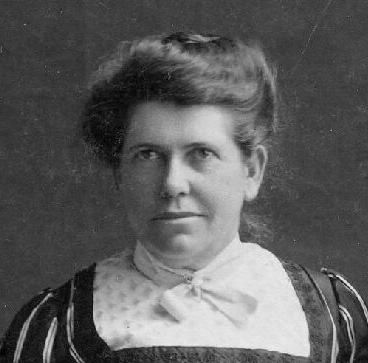
Lydia Lucetta Sackett (1854–1931)
Lydia Lucetta Sackett, daughter of David Alexander Sackett and Sarah Lawrence, was born in Beavercreek, Benton County, OregonG, on 1 June 1854. She died aged 77 on 7 November 1931. She married in Petaluma, Sonoma County, CaliforniaG, on 18 October 1871, George Walter Ormsby. George was born in Dane, WisconsinG, on 13 April 1847. He died in Ventura, CaliforniaG, on 2 March 1940.
In 1860 Lydia was living in Petaluma, Sonoma County, CaliforniaG, in the household of her father David and stepmother Emaline, and was recorded in the census as Lusetta Sackett, aged six and born in Oregon.2
In 1880 she was living in Vallejo, Sonoma County, CaliforniaG, in the household of her husband George, 33, a farmer, and was recorded as Lucetta L Ormsby, aged 26. Living with them were their children, Julia, 7, Ernest, 4, and Ella, aged two.3
In 1860 Lydia was living in Petaluma, Sonoma County, CaliforniaG, in the household of her father David and stepmother Emaline, and was recorded in the census as Lusetta Sackett, aged six and born in Oregon.2
In 1880 she was living in Vallejo, Sonoma County, CaliforniaG, in the household of her husband George, 33, a farmer, and was recorded as Lucetta L Ormsby, aged 26. Living with them were their children, Julia, 7, Ernest, 4, and Ella, aged two.3
Children of Lydia Lucetta Sackett and George Walter Ormsby
- Julia Belle Ormsby+ b. 1 Nov 1872, d. 28 Mar 1957
- Ernest Walter Ormsby b. 11 May 1876
- Ella Noreen Ormsby b. 8 Mar 1878
- Edna Ormsby b. 25 Sep 1887
| Sackett line | 8th great-granddaughter of Thomas Sackett the elder of St Peter in Thanet 6th great-granddaughter of Simon Sackett the colonist |
Notes & Citations
- Charles Weygant, The Sacketts of America, not recorded.
- 1860 United States Federal Census, Roll M653_69, p. 586, Image 586, FHL film 803069
Petaluma, Sonoma County, California
D A Sackett, 39, farmer, real estate $5,000, personal estate $4,000, b. OH
Emaline Sackett, 26, b. ME
Saml Sackett, 19, b. IL
Henrietta Sackett, 11, b. IL
Emma Sackett, 9, b. IL
Lusetta Sackett, 6, b. OR
Annett Sackett, 3, b. CA
Eliza McCarty, 22, servt, b. Ireland
Edwin Goodall, 17, b. England. - 1880 United States Federal Census, Roll 84, FHL Film 1254084, p. 30C, Enumeration District 121, Image 0062
Vallejo, Sonoma County, California, 10 Jun 1880
Ormsby, George W, head, 33, farmer, b. WI, father b. OH, mother b. NY
Ormsby, Lucetta L, wife, 26, keeping house, b. OR, father b. OH, mother b. England
Ormsby, Julia B, dau, 7, at school, b. CA, father b. WI, mother b. OR
Ormsby, Ernest W, son, 4, b. CA, father b. WI, mother b. OR
Ormsby, Ella B, dau, 2, b. CA, father b. WI, mother b. OR.
| Charts | Line 3 (American) |
| Generation.Tree | 9Q.3 |
| Last Edited | 12 Oct 2018 |
| Research Status | Partly researched |
Sarah Anetta Sackett
| Father | David Alexander Sackett (1821-1895) |
| Mother | Sarah Lawrence (1819-1859) |
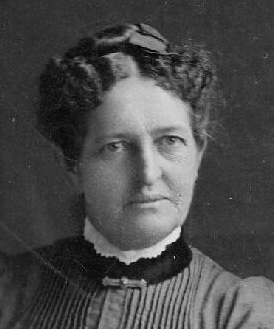
Sarah Anetta Sackett (1857–)
Sarah Anetta Sackett, daughter of David Alexander Sackett and Sarah Lawrence, was born in Petaluma, Sonoma County, CaliforniaG, on 27 September 1857.1
In 1860 Sarah was living in Petaluma, Sonoma County, CaliforniaG, in the household of her father David and stepmother Emaline, and was recorded in the census as Annett Sackett, aged three and born in California.2
In 1860 Sarah was living in Petaluma, Sonoma County, CaliforniaG, in the household of her father David and stepmother Emaline, and was recorded in the census as Annett Sackett, aged three and born in California.2
| Sackett line | 8th great-granddaughter of Thomas Sackett the elder of St Peter in Thanet 6th great-granddaughter of Simon Sackett the colonist |
Notes & Citations
- Sackett database, 4191 Sarah Anetta Sackett.
- 1860 United States Federal Census, Roll M653_69, p. 586, Image 586, FHL film 803069
Petaluma, Sonoma County, California
D A Sackett, 39, farmer, real estate $5,000, personal estate $4,000, b. OH
Emaline Sackett, 26, b. ME
Saml Sackett, 19, b. IL
Henrietta Sackett, 11, b. IL
Emma Sackett, 9, b. IL
Lusetta Sackett, 6, b. OR
Annett Sackett, 3, b. CA
Eliza McCarty, 22, servt, b. Ireland
Edwin Goodall, 17, b. England.
| Charts | Line 3 (American) |
| Generation.Tree | 9Q.3 |
| Last Edited | 31 Jul 2015 |
| Research Status | Partly researched |
Julia Belle Ormsby
| Father | George Walter Ormsby (1847-1940) |
| Mother | Lydia Lucetta Sackett (1854-1931) |
Julia Belle Ormsby, daughter of George Walter Ormsby and Lydia Lucetta Sackett, was born in Petaluma, Sonoma County, CaliforniaG, on 1 November 1872.1 She died aged 84 in Ventura, CaliforniaG, on 28 March 1957.2 She married David John Reese.3
In 1880 Julia was living in Vallejo, Sonoma County, CaliforniaG, in the household of her parents George and Lucetta, and was recorded in the census as Julia B Ormsby, at school, aged seven and born in California.4
In 1880 Julia was living in Vallejo, Sonoma County, CaliforniaG, in the household of her parents George and Lucetta, and was recorded in the census as Julia B Ormsby, at school, aged seven and born in California.4
Child of Julia Belle Ormsby and David John Reese
- Anna Margaret Reese+ b. 3 Dec 1912, d. 25 Feb 2002
| Sackett line | 9th great-granddaughter of Thomas Sackett the elder of St Peter in Thanet 7th great-granddaughter of Simon Sackett the colonist |
Notes & Citations
- Sackett database, 23659 Julia Belle Ormsby.
- "California, Death Index, 1940–1997" (Ancestry transcript), "Julia Belle Reese, b. California, 1 Nov 1872, d. Ventura, 28 Mar 1957, father Ormsby, mother Sackett."
- Email from Nina J Rhys to Terri Carlson, Mar 2015.
- 1880 United States Federal Census, Roll 84, FHL Film 1254084, p. 30C, Enumeration District 121, Image 0062
Vallejo, Sonoma County, California, 10 Jun 1880
Ormsby, George W, head, 33, farmer, b. WI, father b. OH, mother b. NY
Ormsby, Lucetta L, wife, 26, keeping house, b. OR, father b. OH, mother b. England
Ormsby, Julia B, dau, 7, at school, b. CA, father b. WI, mother b. OR
Ormsby, Ernest W, son, 4, b. CA, father b. WI, mother b. OR
Ormsby, Ella B, dau, 2, b. CA, father b. WI, mother b. OR.
| Charts | Line 3 (American) |
| Generation.Tree | 10R.3 |
| Last Edited | 12 Oct 2018 |
| Research Status | Partly researched |
 Charles Vincent Giles
| Father | Charles Giles (1842-) |
| Mother | Julia Catherine Cook Sackett (1845-1924) |
Charles Vincent Giles, son of Charles Giles and Julia Catherine Cook Sackett, was born in Maresfield, SussexG, on 29 November 1870.1 He married about 1907, Anna Plumb.1 She was born in EssexG in 1867.1
Children of Charles Vincent Giles and Anna Plumb
- Arthur William Sackett Giles+1 b. 27 Sep 1908, d. c 1983
- Anna Mary Catherine Giles1 b. 28 Oct 1910
| Sackett line | 8th great-grandson of Thomas Sackett the elder of St Peter in Thanet 1st cousin 8 times removed of Simon Sackett the colonist |
Notes & Citations
- Emails from Jake Braden to Chris Sackett, March 2006.
| Charts | Line 3 (English) |
| Generation.Tree | Q.3 |
| Last Edited | 5 Apr 2013 |
| Research Status | Partly researched |
 and
and  are links to Text and Image exhibits.
 English line of Thomas Sackett the elder & other English lines
 American line of Thomas Sackett the elder through Simon Sackett the colonist
 Line of John Sackett of New Haven